
Low E Glass represents one of the greatest advancements in the energy efficiency of modern-day glass products, from common residential uses to iconic commercial projects. Low E glass has transformed the glazing world and promoted the greater use of glass facades. This technical bulletin traces the evolution of low-e coatings and benefits of these state-of-the-art products.
Low-emissivity, or low-e glass is designed to reduce infrared and ultraviolet light transmission while allowing visible light to enter interior spaces. Low-e coatings help reduce the amount of solar heat entering a building, which keeps the interior cooler and lowers energy use for air conditioning.
Types of Low-E Glass: Hard Coat vs. Soft Coat
There are two main types of low-e glass: hard coat and soft coat. Both types have different properties, applications, and benefits.
- Hard Coat Low-E Glass : Hard coat low-e glass is made by depositing the coating onto the glass when it is still hot and in a semi-molten state. This method, called pyrolytic deposition, forms a tough coating that adheres to the glass surface. This coating is known to be more durable, especially for applications in which glass is exposed to harsh environment conditions.
- Soft Coat Low-E Glass : This type of low-e glass is produced by a process called vacuum sputtering with a thin layer of metallic or metal oxides on the glass. This method allows for more precise control over coating properties, enhancing energy efficiency and optical clarity.
Sputter Coating
Low-E sputter coated glass is comprised of microscopically thin layers that are organized in “stacks”, reflecting heat while maintaining transparency. Among these microscopic layers are silver and dielectric or ceramic materials, which contribute significantly to the performance properties of the coating. By manipulating the thickness and composition of materials in a Low-E coating stack, glass engineers can control the visual and thermal properties of the glass. These variations may drastically reduce heat and light passing through, while limiting the exterior or interior reflectivity.

Single-Silver
The earliest low-e coatings were composed of one layer of silver and two ceramic layers in a five-component stack. The silver layer blocked heat by reflecting infrared and ultraviolet light, while the dielectric layers protected and reduced the reflective properties of the silver layer.
Double-Silver Coatings
In the early 1990s, glass manufacturers transformed low-e glass fabrication with the introduction of the first double-silver-coated glasses. These glasses feature two layers of silver and multiple micro-thin layers of active/proactive performance materials. Double silver coatings enabled this generation of low-e glasses to maintain the same levels of visible light transmittance as single silver low-e coatings while increasing their ability to block solar heat gain (infrared and ultraviolet light) by more than 30%.
Triple-Silver Coatings
In 2005, glass manufacturers introduced the modern, state-of-the-art low-e coatings, which feature three layers of silver and multiple layers of dielectric material in over 12-layer stacks as thin as 300 nanometers. Triple-silver low-e coated glasses can transmit nearly 70% of the sun’s available light into a building while blocking up to 75% of its infrared and ultraviolet energy.
Quad-Silver Coatings
Finally, quad-silver coatings, which are state-of-the-art advancements introduced in 2016, can block nearly 80% of the sun’s radiant energy while transmitting more than 50 percent of available sunlight.
Recent advancements include the use of a high-performance low-e coating on the second surface in combination with a fourth surface pyrolytic coating.
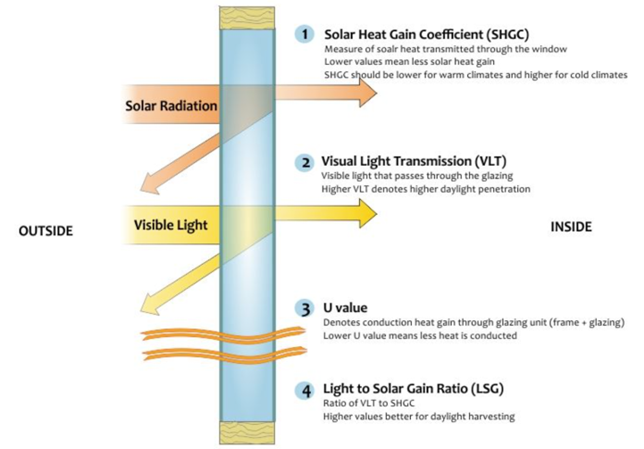
The performance of coatings, or different combinations of substrates and coatings, is assessed according to these factors:
In conclusion, over the course of many decades, glass manufactures have been able to increase the number of active silver and dielectric layers in low-e coatings without increasing the thickness of the coatings. This has enabled them to make low-e architectural glass highly transparent while simultaneously increasing their ability to reflect heat energy.
With these advances in low-e coating technology, architects can continue to specify large expanses of transparent glass to deliver the benefits of daylighting while enhancing a building’s energy and environmental performance.