
One of the recent product improvements in the glazing industry has led to another innovative way to enhance energy efficiency. The emergence of Vacuum Insulated Glass is a promising technology for new and existing glazing applications and is the subject of this Technical Bulletin.
Vacuum Insulated Glass (or VIG) is a type of glazing that consists of two or more glass lites, separated by a narrow vacuum gap. This gap is created using support “pillars”, which are microscopic and are evenly spaced between the lites. This arrangement maintains the structural integrity of the glass while preserving the insulating properties.
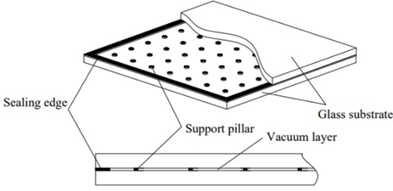
The benefits of a Vacuum Insulating Glass assembly.
-
Thermal
In traditional insulated glass with an air space between the lites, some heat transfer through conduction and convection still occurs. In contrast, the vacuum in this gap eliminates these pathways and the heat transfer is dramatically reduced. This results in superior U-Values compared to other glazed insulated products.
-
Acoustic
The vacuum gap also acts as a sound barrier, dampening external noise. Sound cannot exist in a vacuum, which is why Vacuum Insulated Glass is superior in acoustics to monolithic products. It should be noted that opinions vary as to the degree of benefit, as some believe that additional testing may prove that the acoustic performance of Vacuum Insulated Glass rivals that of insulated glass or laminated glass assemblies.
-
Infill Thickness
Vacuum Insulated Glass in commercial applications are typically comprised of two lites of 4mm or 6mm glazing, for an overall infill thickness of 8.3mm to 12.3mm. This is not only useful in new installations but allows for the replacement of existing monolithic glazing applications without having to change the framing system.
-
Hybrid Assemblies
Vacuum Insulated Glass can be used on the inboard lite of an insulated glass unit with an additional coating, resulting in an assembly with extraordinary performance.
Sample Comparison Chart: Using Vitro VacuMax with Solarban 70 Coating
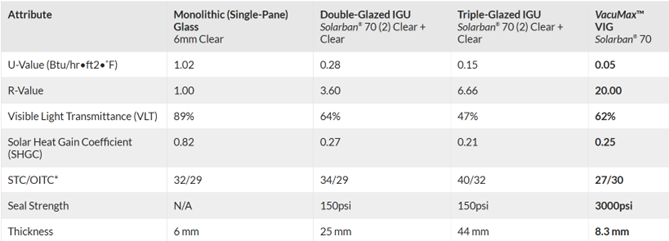
The cost per square foot of a 8.3mm Vacuum Insulated Glass assembly is roughly three times the cost of conventional insulated/coated glass products, making a long-term payback analysis essential. In addition, some manufactures currently limit the maximum size to roughly 60” X 120”, which may limit some installations.
Key areas of future development include:
-
Performance
As the glazing industry continues to advance, manufacturers are developing improved sealants, exploring alternative support pillar materials, and investigating innovative ways to further improve the insulating properties. New coatings may be developed to further enhance energy saving and soundproofing properties, making it an even more attractive option for buildings.
-
Lowering Costs
As production methods improve and economies of scale are achieved, the cost of manufacturing Vacuum Insulated Glass is expected to decrease, making it more accessible for a wider range of applications.
-
Integration with Smart Technologies
Vacuum Insulated Glass may be integrated with smart technologies such as dynamic glazing or sensors to adjust transparency and insulation based on environmental conditions, providing additional energy savings and customization options.
In conclusion, Vacuum Insulated Glass is an effective long-term solution for energy-efficient glazing in new or existing buildings with its superior insulating properties. This glazing assembly is also highly durable with an anticipated long lifespan, making it a potential value-added product and a sustainable solution.
Click Here to View the Technical Bulletin in PDF.