
One of the more difficult tasks of the glazing industry is managing the bidding and procurement of door hardware. In this SCGMA Technical Bulletin, we address the way this information is presented, the role of the Glazing Contractor and tips for navigating challenges.
When bidding a project, the typical door schedule on the architectural drawings will provide door numbers, sizes, door types, frame types, materials and finish, ratings (if any) and in most cases a designated hardware group for each door.

This schedule also pictorially shows the door types and configuration, i.e. swing, slide, etc., as well as any relevant rail or stile dimensions.
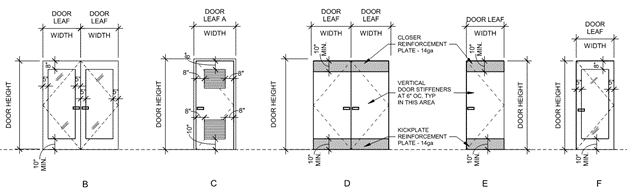
For the glazing trade, the door hardware information is generally found contained within either specification 08 4113 Aluminum Storefront & Entrances or 08 7100 Door Hardware. It is important to thoroughly review both sections as they will typically cross reference as to whose responsibility it is to furnish the materials.
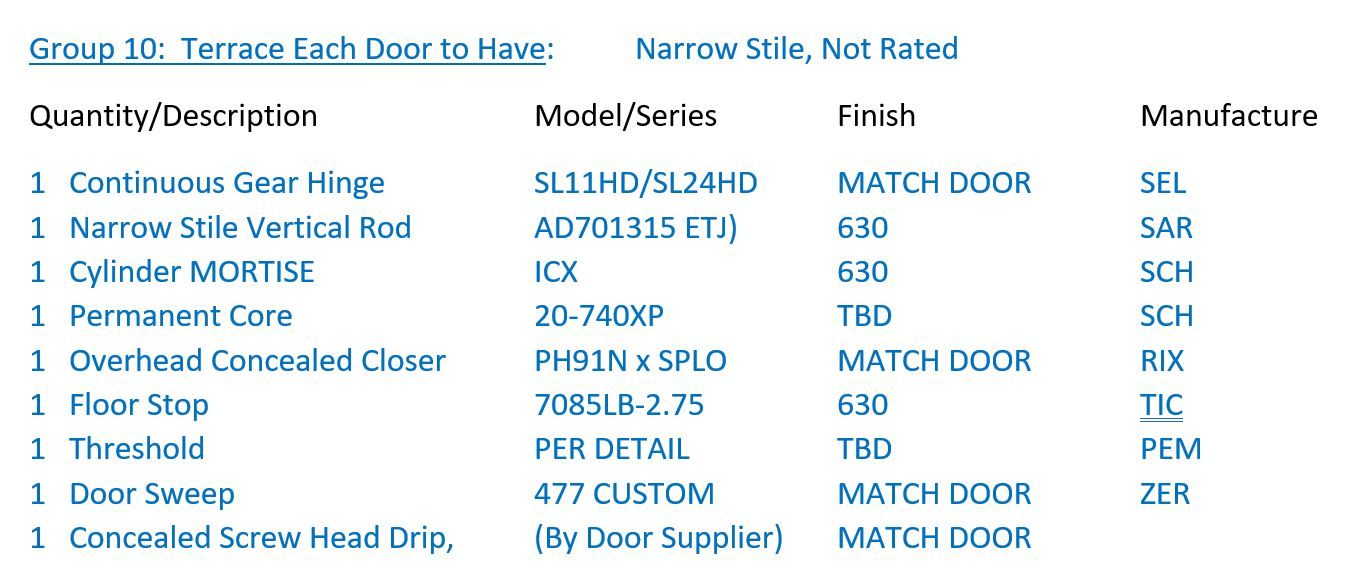
Within 08 7100 Door Hardware, the hardware group numbers referenced on the architectural drawings list the required hardware per set along with the manufacture, model number and finish for each item. Also contained in the specified hardware sets, notes are made as to items not provided by the hardware supplier and anticipated to be furnished by the door manufacture or glazing contractor, such as thresholds, door sweeps, pivots, door stops, etc.
In the body of specification 08 7100, look for “keys” to the abbreviations found in the groups, along with finishes referenced to BHMA (Builders Hardware Manufactures Association) and/or ANSI (America National Standards Institute). A typical hardware set with these “key” examples would be as follows.
As we all know, this guideline comes with many variations. Unless it is specifically noted within the Contractors Instructions to Bidders or Scope of Work, it generally understood that at a minimum the Glazing Contractor should price the scope specifically called out in the Aluminum Storefront & Entrance specification section. In addition, pricing should include the door fabrication and installation of the hardware provided by others per the Door Hardware section. Last, in some cases the contractors Scope of Work may also require pricing of the glazing contractor’s door hardware groups as listed in section 08 7100.
Bidding
For bidding purposes, if the information is complete, the goal is to get the scope of work correct in order to maintain a complete competitive bid while covering costs. In that case, the best practice would be to send this information out to door fabrication vendors and door hardware suppliers, if appropriate.
If bidding information is not complete or the scope of work is not defined, it is a common practice to offer and include a per leaf door hardware allowance in pricing. When providing an allowance, it would be appropriate to clarify what hardware would be included (manufactures standard closers, panics, pulls, etc.) and to exclude specialty hardware such as card readers, custom pulls, power-assist operators, etc.
Finally, it is also critical to compare the hardware product warranties to those specified to ensure that the manufactures comply with required coverage. If warranty gaps occur, clarifying the limits of the product warranties should be noted in the bid proposal.
Procurement
Experience has shown that if it’s possible to buy the hardware with the door fabrication, the risk to the glazing contractor is reduced. This is much easier with simplified, non-specialized door hardware requirements. Door fabricators are better suited to identify incompatible products, door hardware limitations and/or dimensional conflicts.
For specialized door hardware requirements, it is recommended to work with a trusted, competent door hardware supplier. The best of these firms will provide competitive pricing, identify problems, drive solutions, manage long lead-time products, coordinate with the door fabricators and manage the hardware submittal/sample process.
Ultimately, the owners, architects and contractors look to the glazier to reconcile hardware issues for their scope. This task will continue to be a challenge, best accomplished with a combination of internal expertise and industry partnering.