
Facade performance requires the proper system selection for the project, but equally important in the longevity of the performance is the design of the sealant joints. In this SCGMA Technical Bulletin, we review the fundamentals of good sealant weatherseal joint design.
Before starting the process of designing a joint, it’s necessary to understand the range of movement that the joint will be required to accommodate.
-Thermal movement. The most significant influence on joint movement is the thermal expansion and contraction of the façade elements. Different materials have different expansion coefficients, and the range of temperature must be identified as this sample shows.
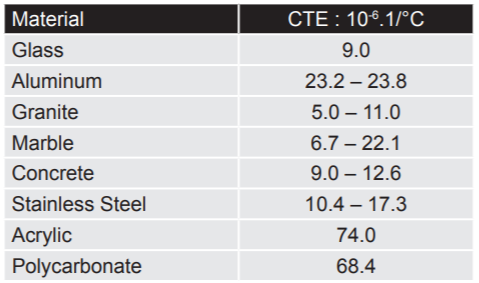
In this example of determining thermal expansion of a piece of aluminum 240” long while accommodating an 80-degree temperature range, the formula would be;
240” (Length) X .000023 (CTE = Coefficient of Thermal Expansion) X 80 (Temperature Range) = .44” or roughly 7/16”.
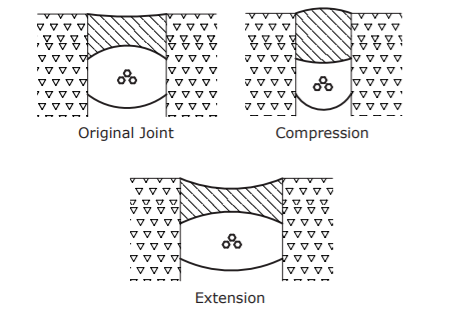
-Extension/Compression. Weatherseal joints typically move in extension and compression. Under extension, the sealant and the bond line of the sealant are subjected to stress as the sealant is extended. Under compression, the sealant will deform and bulge from the joint. The deformation can cause a permanent compression set in a sealant, which may have a detrimental effect on the long-term durability of the sealant.
Sealant manufacturers rate their sealant for movement capability based on the behavior of the sealant in extension and compression. Movement capability values are commonly stated as +/-25%, +/-50% or + 100%/-50% for example.
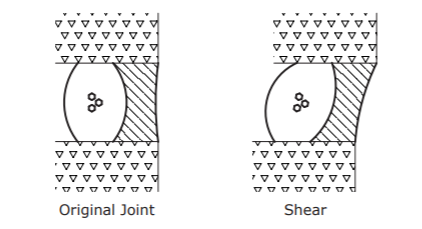
– Shear. Weatherseal joints are also subjected to movement in shear, but is generally not as demanding as extension movement. The real extension is the difference between the original sealant width and the new sealant width after shear movement. This real extension can be used in joint design. To calculate the real extension that a sealant is subjected to under shear, the Pythagorean Theorem can be used as described in the following equation: a² + b² = c² where a = original sealant width b = joint movement in shear c = new sealant width. Sealant manufactures typically provide a calculator that can be used to determine joint movement for extension, compression and shear.
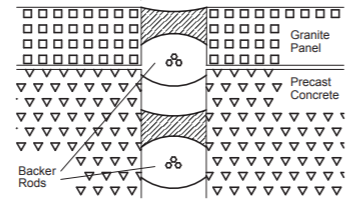
Joint design and joint ratios are also critical in performance and longevity. The rule of thumb is that the sealant joint should be hourglass-shaped and the width should be twice depth (as shown in diagram below).
According to manufactures recommendations, backer rod diameter should be 25% larger than the joint to be filled. Joint size should be 4x the expected amount of movement (usually about 1/2” of space on all sides of the window casement).
Common Joint Types
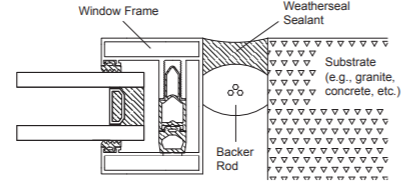
Typical Perimeter Joint
Typical Dual (Secondary) Joint
As always, the last step in the joint application is to confirm the compatibility of the substrates and determining the need for any primers.
Understanding these fundamentals ensures the proper applications of weatherseals and follows the guidelines established by the sealant manufactures.